



The radiographers capable of filling these positions may already serve these communities. Yet many live in an “education desert,” where the nearest mammography training program may be 80 or 100 miles away. For those balancing work and family responsibilities, the time and expense of traveling can put training beyond reach.
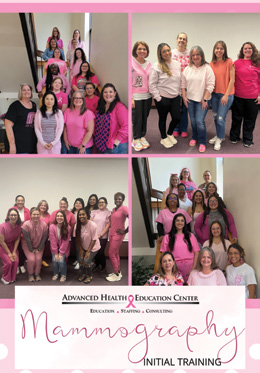 AHEC Foundation addresses these barriers through its GROW! Mammography Fellowship—Growing Opportunities for Women in Radiology.
The registered 501(c)(3) nonprofit funds training and travel, while its training partner, Advanced Health Education Center, delivers instruction and helps fellows access supervised clinical experience. Together, they prepare radiographers to become mammographers and expand local screening capacity.
GROW! began in 2023 after founder Marilyn Sackett reviewed a post-COVID white paper showing that fewer mammographers were working than there were in 2017. Acting on that finding, she helped launch a year-long pilot with Advanced Health Education Center. Six technologists from three states trained at its Houston center and returned prepared to support screening in their rural communities. The pilot’s success led to the formation of the AHEC Foundation and established GROW! as an ongoing fellowship. The fellowship supports two recipients in each of its April and October cohorts, allowing applicants to choose the session that best fits their schedules.
“Our belief is that one opportunity can create infinite possibilities,” says Jence Garza, VP of AHEC Foundation. “That principle guides how we approach this fellowship and invest in every technologist.”
Each group pairs a recent graduate with an experienced technologist. One fellow must have graduated from an accredited medical imaging program within the previous 12 months, while the other must have at least two years of medical imaging experience. Both must be registered with the American Registry of Radiologic Technologists (ARRT) or provide proof of registration by the application deadline.
-
Our belief is that one opportunity can create infinite possibilities. That principle guides how we approach this fellowship and invest in every technologist.
The fellowship covers round-trip airfare, hotel accommodation, rental-car expenses or mileage and a daily allowance for food and incidentals. Fellows attend Advanced Health Education Center’s five-day, 40-hour Mammography Initial Training program in Houston. The curriculum comprises 24 hours of core competencies required under the Mammography Quality Standards Act, eight hours of digital mammography and eight hours of digital breast tomosynthesis.
Clinical preparation continues after the course. Each fellow performs 25 mammograms under a qualified mammographer through her employer, a supporting facility or AHEC’s clinical network. She must also submit a facility participation letter confirming access to the supervision and clinical setting needed to complete 75 additional mammograms for ARRT registry eligibility. This arrangement provides a defined pathway from classroom instruction to registry eligibility.
The fellowship’s effect on patient access is evident in the communities its fellows serve.
At an underserved facility, a shortage of mammographers had left patients waiting weeks for appointments. Within a month or two of returning, a GROW! fellow helped the facility reduce its backlog and detected a patient’s cancer at an early stage. Without the additional mammography capacity she brought to the facility, the patient might have waited another eight weeks for an appointment.
Sustaining Capacity Beyond Registration
Professional development does not end with registry eligibility. As AI, digital imaging and evolving clinical methods reshape radiologic sciences, continuing education helps technologists keep pace with new technologies and strengthen their imaging skills, preparing them to deliver informed patient care.
AHEC Foundation is focused on extending access to specialized training. It has supported technologists from Texas, Louisiana and Arkansas and aims to increase the number of fellowships gradually. Its longer-term vision includes reaching all 50 states and expanding the model into computed tomography while preserving the training and clinical support provided to each participant.
